
Banned Books Week: The Florida Law That Opened the Floodgates
Florida parents already had the right to object to materials used by their own children. Donalds’s 2017 law opened the process to other county residents — and Florida soon led the nation in school book bans.
There is an important difference between saying:
“I don’t want my child to read this book.”
and saying:
“I don’t want your child to have access to this book either.”
The first is parental choice.
The second is a decision about the rights of an entire community.
As Banned Books Week 2026 comes to an end, that distinction, and the Florida law that blurred it, is worth remembering.
Florida parents already had a statutory process for objecting to instructional materials used by their own children when, in 2017, then-state Rep. Byron Donalds, now the Republican candidate for governor, sponsored HB 989, which significantly expanded that authority.
Donalds’s bill changed Florida law so that objections could be filed not only by parents, but by any resident of the county. It also expressly extended the challenge process to materials “made available in a school library.”
That was a meaningful shift.
You no longer had to be objecting to something assigned to your own child. You did not even have to have a child attending the public schools. A county resident could initiate a process challenging whether a book should remain available to other people’s children.
Donalds has not left that law in his political past.
His current campaign for governor touts it as an accomplishment, describing HB 989 as a “first-in-the-nation bill allowing parents and community members to review instructional materials in schools.”
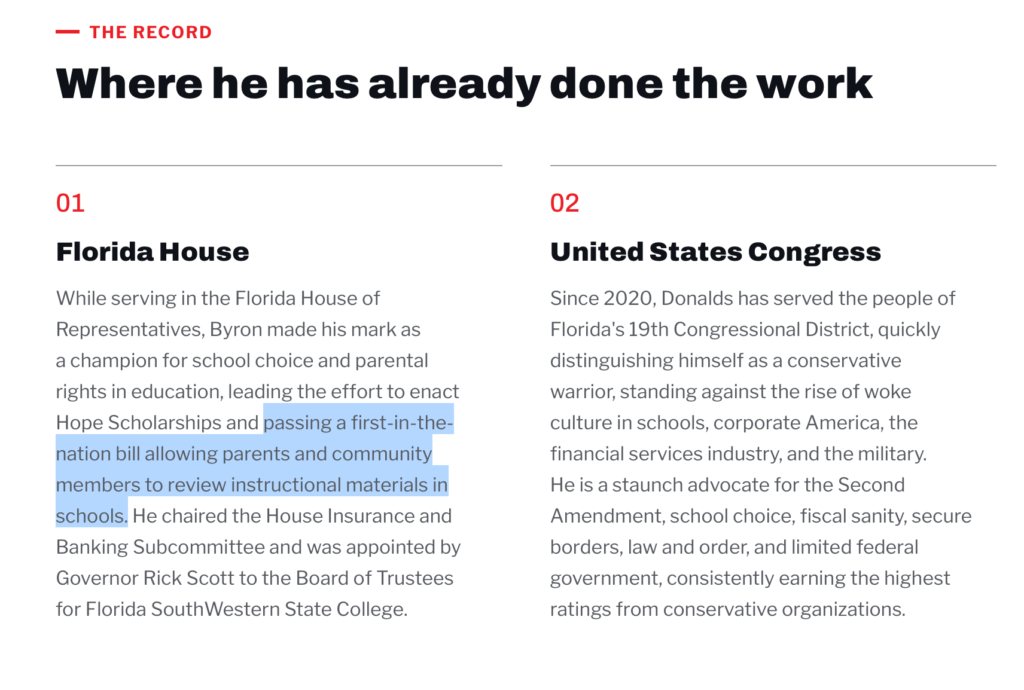
That description leaves out an important part of the history: Florida parents ALREADY had a statutory objection process.What Donalds’s bill added was the power of other county residents (including people with no child enrolled in the public schools) to initiate challenges to materials available in school libraries.
Bring on the challenges
For several years, that distinction attracted relatively little attention.
Then Florida’s culture war over school library books exploded.
During the 2022–23 school year, Florida school districts reported 1,218 objections to books and other materials. Those objections resulted in hundreds of removals.
But those 1,218 objections were not the work of 1,218 concerned parents each worried about something their own child had brought home.
More than half came from just two school districts: Clay and Escambia counties.
Clay County reported 489 objections.
Escambia County reported 215.
Together, two of Florida’s 67 school districts accounted for 704 of the state’s 1,218 objections (nearly 58 percent).
And within those districts, the challenges were driven disproportionately by just a couple of people.
In Clay County, Bruce Friedman became responsible for virtually all of the district’s enormous wave of objections. Reporting at the time found that he alone accounted for more than one-third of all book challenges filed across Florida. Although Friedman is a father, his child was not enrolled in Clay County public schools and Donalds’ 2017 law did not require that he have a child attending the schools whose libraries he was challenging.
In Escambia County, high-school English teacher Vicki Baggett launched a campaign challenging more than 100 books. By September 2022, she had submitted objections to at least 113 titles, setting off years of reviews, restrictions, school-board votes and litigation.
Florida became the national epicenter
The results extended far beyond those two districts.
According to PEN America, Florida recorded 1,406 school book bans in 2022–23. That was more than any other state and more than 40 percent of all the bans PEN documented nationwide that year.
The following year, Florida again led the country, with 4,561 book bans during the 2023–24 school year.
Florida no longer holds the top spot. In the new report released for Banned Books Week 2026, Texas ranked first, while Florida ranked second with more than 3,000 school book removals in 2025–26.
But by then the volume of challenges in Florida had become so great that even Gov. Ron DeSantis said the process was being abused.
In 2024, DeSantis complained that some people were using the law to “object to every single book” and “make a mockery of this.” He acknowledged that some books being pulled into review were “just normal books that have been in education for many many years.”
His administration said the law needed to be changed to protect schools from activists trying to “politicize and disrupt a district’s book review process.”
And Florida did change it.
Under HB 1285 (2024), a county resident who is not the parent or guardian of a student with access to district materials was limited to one objection per month. Parents and guardians remained free to file unlimited objections.
That history matters when Byron Donalds now points to his 2017 law as an accomplishment.
Florida already had a process for parents to object to materials used by their own children. Donalds helped open that process to people with no children in the public schools and explicitly extended it to books in school libraries.
What followed was a system in which individual activists could file hundreds of objections, two districts could account for well over half of the objections in the entire state, and Florida could rise to the top of national book-ban lists.
Eventually, even Ron DeSantis said activists were using the process to “make a mockery” of it, and the Legislature had to place new limits on the very non-parent challengers Donalds’s law had empowered.
So during Banned Books Week, it is worth remembering the part Byron Donalds played in how Florida got here.
He did not create parents’ right to object to what their own children read. That right already existed. What his 2017 law did was open the door much wider, allowing outside activists to challenge what everyone else’s children could read. Florida spent the years that followed dealing with the consequences.