
Commissioner Mack says competition is improving EVERYTHING. Show Us The Data.
On October 22, the Florida Department of Education shared a social media postcelebrating Commissioner Henry Mack’s call to expand school choice and double down on the state’s investments in parental options.
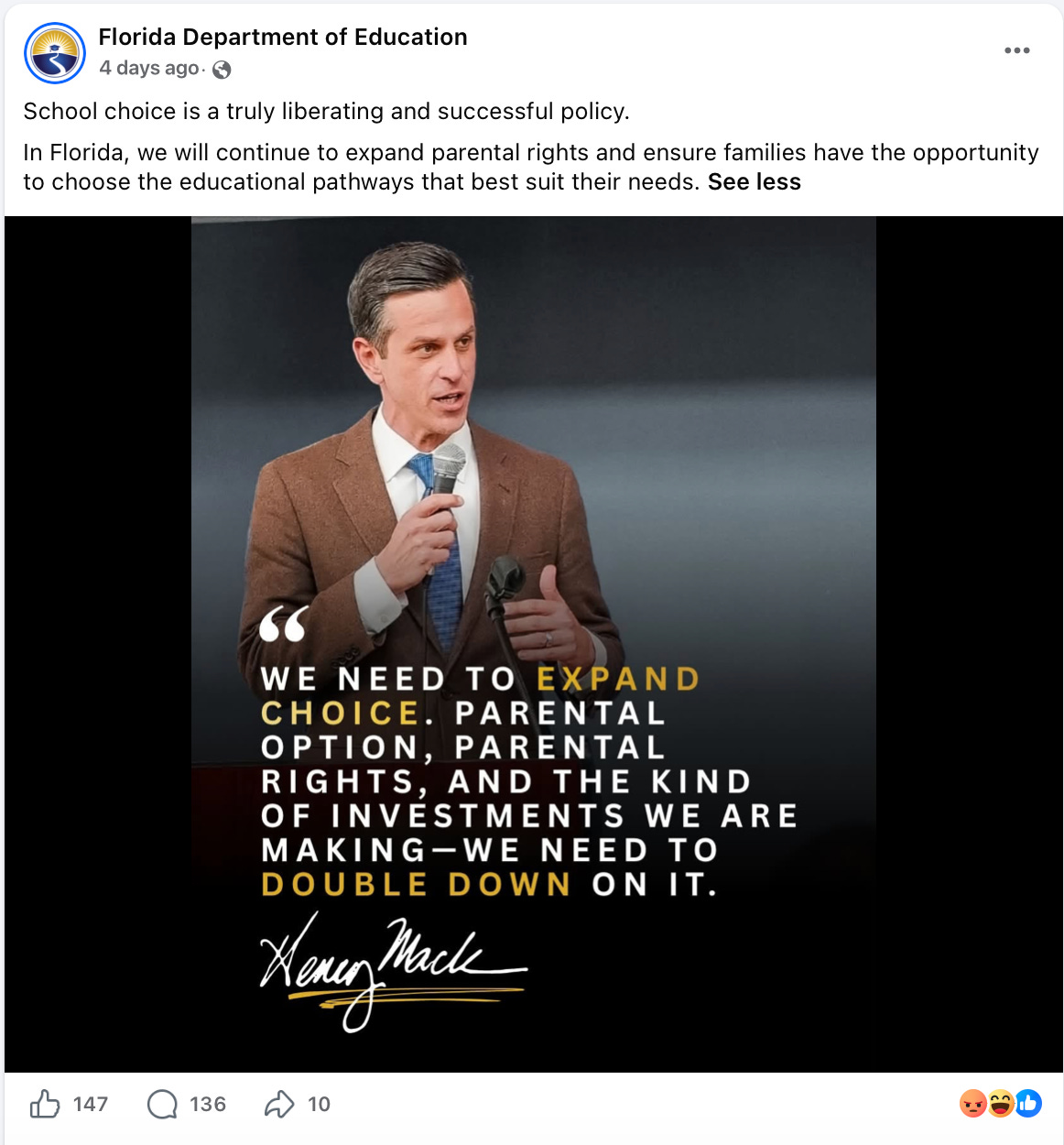
The quotation came from Mack’s October 21 appearance on The Morning Show with Preston Scott. During the 24-minute interview (listen here at 1:04:00), Mack made a sweeping assertion about Florida’s education system:
“Everything is getting better as a result of the competition.”
Really? Everything?
To paraphrase Jerry Maguire: “Show me the data!”
Florida’s public schools have demonstrated improvements on recent state assessments, although national assessments tell a less encouraging story. Past research suggested that competition from school choice programs might produce small improvements in public-school performance.
But neither establishes that Florida’s massive expansion of universal vouchers has improved academic outcomes across every educational sector.
Competition Is Improving Everything. Says Who?
Early in the interview, Preston Scott asked Mack what Florida needed to do to make its education system the best in the nation, if not the world.
Mack emphasized strengthening connections between education and workforce needs. Then he turned to school choice.
“We need to expand choice. Parental option, parental rights, and the kind of investments we are making, I think we need to double down on it.”
He argued that giving parents more money to make educational decisions improves outcomes in public schools, charter schools, and private schools:
“It improves outcomes across the private schools. public charters, the
public choice, the non-public choice, everything. Everything is getting better
as a result of the competition.”
How does he know?
A frequently cited 2014 study by David Figlio and Cassandra Hart found statistically significant but very small improvements in public-school test scores associated with competition from Florida’s original Tax Credit Scholarship (FTC) program.
How small? The researchers estimated improvements of roughly 0.01 to 0.03 standard deviations, depending on the measure of private-school competition. An improvement of 0.02 standard deviations is equivalent to moving a student from the 50th percentile to approximately the 51st percentile.
The study examined a means-tested scholarship program serving fewer than 20,000 low-income students annually. It also took place during a period when Florida was implementing major accountability reforms, including A–F school grades, expanded testing, and third-grade reading retention. A lot has happened since then.
The researchers attempted to separate the effects of competition from those of school accountability. Their findings provide evidence that competitive pressure may have contributed modestly to public-school improvement.
But they did not establish that competition resulting from FTC participation in 2014 was the principal cause of Florida’s academic gains, much less that today’s universal scholarship system, projected to serve nearly 580,000 students across multiple programs, is improving outcomes everywhere.
Mack is presenting a possible explanation as though it were a demonstrated fact.
Are Public and Private Schools Really Held to Consistent Standards?
Perhaps the most revealing exchange came at 1:11:45, when Preston Scott raised the issue of different accountability requirements for public and private schools. Scott characterized the concern as a talking point frequently advanced by school choice opponents, “often at the behest of teachers’ unions,” and invited Mack to respond.
Mack dismissed the criticism as “unfounded” and “not true.”.
“We know that standards are consistent across both public and private.”
Mack explained that private schools administer assessments and report student-learning data, suggesting that Florida can compare student performance across public and private schools.
But Florida’s own scholarship evaluations say otherwise.
In its 2023–24 evaluations of both the FTC and FES programs, Florida State University’s Learning Systems Institute (LSI) explicitly declined to compare scholarship students’ academic performance with that of public-school students because they take different assessments.
The FTC report goes further, explaining that there is no established correspondence between FAST and the nationally norm-referenced tests administered to scholarship students. LSI concludes that direct comparisons are not valid.
So while Commissioner Mack insists Florida has the data to compare public and private school performance, the researchers Florida hired to evaluate its scholarship programs say the existing test results cannot be directly compared.
And assessments aren’t the only area where Florida’s requirements differ.
Mack also seems to be confusing several different meanings of the word standards.
All schools can have high standards for students, meaning high expectations for academic achievement, behavior, and personal development. Private schools may have exceptionally high expectations.
But Florida’s state academic standards are something different.
Public schools must teach Florida’s adopted academic standards, including the B.E.S.T. Standards in English language arts and mathematics. Scholarship-funded private schools are not required to do so.
Then there are graduation standards.
Mack celebrated Florida’s rising graduation rate as evidence of educational success. But public schools must meet state-established graduation requirements, including specified coursework, minimum GPA, and required assessments or qualifying alternatives.
Private schools establish their own graduation requirements. Their diplomas do not necessarily represent completion of the same requirements imposed on public-school students.
And private schools don’t even have to be accredited to receive taxpayer-funded scholarships.
When Scott asked whether private schools have baseline standards they must meet, Mack pointed to accreditation, stating that many private schools are accredited by organizations that also accredit public schools.
That may be true of some individual private schools. But accreditation is not required for FTC or FES participation and, as of March 2026, only 24% were, per FLDOE reports. FLDOE itself states that it does not accredit private schools or officially recognize the organizations that do. Accrediting organizations also vary in their requirements.
None of this means private schools necessarily provide an inferior education. Many offer rigorous academic programs, and some exceed the state’s minimum expectations.
The issue is what Florida requires of publicly funded schools.
Public schools must follow state academic standards, participate in statewide assessments, meet state graduation requirements, and face public accountability consequences tied to performance.
Scholarship-funded private schools operate under different requirements. They generally use approved norm-referenced assessments rather than FAST, do not receive A–F school grades, and are not subject to the same academic intervention framework.
Mack could argue that private schools should have greater flexibility. That’s a legitimate policy position.
But greater flexibility is not the same thing as consistent standards. Florida law clearly establishes different requirements for public and private schools.
When Mack Needs Evidence of Improvement, He Turns to Public-School Data
Here’s where the interview becomes especially interesting.
After claiming that competition is improving outcomes everywhere and dismissing concerns about different accountability requirements, Mack discussed Florida’s recent academic gains.
He celebrated rising reading and mathematics achievement, higher graduation rates, and growing numbers of students earning workforce credentials.
Then he cited specific results from Florida’s FAST Progress Monitoring system.
According to Mack, the first progress-monitoring administration of 2026–27 showed that 42% of students were performing at or above grade level in English language arts, up three percentage points from the previous fall. Mathematics was at 17%, up one percentage point.
These are encouraging beginning-of-year results. FAST measures student progress toward end-of-year expectations and provides teachers with information to adjust instruction.
But here’s the thing:
FAST Progress Monitoring is part of Florida’s PUBLIC-school assessment system.
Scholarship-funded private schools generally do not administer FAST. Their students typically take approved nationally norm-referenced assessments and cannot participate in the first two FAST progress-monitoring administrations.
To be fair, Mack did not explicitly suggest that his FAST figures included private-school students.
But after claiming that competition is improving academic outcomes across every sector, the specific evidence he offered came from public schools.
He dismissed concerns about different accountability systems, then relied on data from the very public-school accountability system that private schools are not required to participate in.
And there’s another question: Why assume competition deserves the credit for those public-school gains?
What Else Might Explain Florida’s Public-School Gains?
Florida has spent decades implementing reforms intended to improve public-school achievement.
Jeb Bush might credit his test-based accountability system and A–F school grades.
Ron DeSantis might credit the B.E.S.T. Standards and Florida’s FAST Progress Monitoring system for helping teachers identify learning gaps and adjust instruction.
Legislators might point to investments in teacher professional development, instructional coaching, or changes in certification and preparation requirements.
District leaders might credit improvements in curriculum, instructional practices, attendance, or school leadership.
Or perhaps schools have simply become very good at teaching to the test.
More likely, several factors are operating simultaneously.
What do these possibilities have in common?
They largely involve policies and accountability systems specifically required of Florida’s public schools.
Private schools may voluntarily adopt similar practices, but they are not subject to the same statewide requirements.
Florida has spent decades developing an elaborate system of academic standards, assessments, school grades, interventions, and consequences, all intended to improve public-school performance.
(Indeed, much of this blog has been devoted to documenting how ridiculously overbearing that system has become.)
If public-school performance improves, shouldn’t we at least consider whether those reforms and the work of public-school educators contributed to the results?
And if those reforms aren’t contributing to improvement, why do we continue to impose them?
Instead, Mack attributes the improvement to competition.
That’s a claim about causation, not simply a description of academic progress.
It requires evidence distinguishing competition from the many other reforms occurring in Florida’s public schools.
And even if competition has helped public schools improve, that tells us nothing about whether voucher students themselves are achieving better academic outcomes.
Those are two different questions. Taxpayers deserve answers to both.
Where Is Florida’s Private-School Data?
During the interview, Mack insisted that Florida has information about teaching, learning, and quality across public and private schools.
Florida law does require academic testing for many scholarship students and annual evaluations of its FTC and FES scholarship programs.
But the most recent publicly available evaluations cover 2023–24.
The 2024–25 evaluations remain unpublished.
In response to my inquiry, Adam Emerson, Executive Director of FLDOE’s Office of Independent Education & Parental Choice, confirmed that the report “is not ready for publication yet.”
We are now well into the 2026–27 school year.
The public still cannot review the required academic evaluation for 2024–25, the second year following Florida’s expansion to universal scholarship eligibility.
And even when those reports are available, they do not provide the same school-level academic accountability system used for public schools.
Public schools report statewide assessment results, receive A–F grades when eligible, and face consequences for poor performance. Scholarship-funded private schools generally take different assessments and are not subject to the same performance reporting or intervention requirements.
The annual university evaluations provide useful information about scholarship student achievement and growth. But they are not a complete substitute for the public-school accountability system.
If the Commissioner believes Florida already has the data to compare educational outcomes across sectors, why can’t the public see timely, meaningful comparisons?
Parental Choice Is Not the Same as Public Accountability
Mack also made his philosophy of accountability clear.
When discussing private-school quality, he argued that giving parents money to select schools is itself the accountability mechanism. Parents choose the schools they believe are best, and schools that fail to satisfy families will eventually close.
Parental choice certainly provides one form of accountability.
But for parental choice to function as an effective accountability mechanism, parents need reliable, transparent, and comparable information about the schools they are choosing.
Florida provides detailed academic performance data for public schools, including student achievement, learning gains, and school grades. Parents can compare public schools using a common set of measures.
Families considering scholarship-funded private schools do not have access to the same level of comparable academic information. Private schools may administer different assessments, follow different academic standards, and establish their own graduation requirements. They do not receive state A–F grades.
How are parents supposed to make informed comparisons when the state does not provide comparable information about academic performance across publicly funded schools?
If parental choice is the accountability system, shouldn’t Florida provide parents with the information they need to make those choices?
But parental satisfaction is not a substitute for independently measuring whether children are learning. Nor is it a substitute for meaningful oversight of how public education dollars are spent.
These are different responsibilities.
- Parental choice and satisfaction tells us whether families have meaningful options, reliable information to compare them, and confidence that their selected school meets their children’s needs.
- Academic accountability tells us whether students are learning and making progress toward educational expectations.
- Fiscal accountability tells us whether taxpayer dollars are spent for authorized purposes, properly documented, and independently reviewed.
Florida does impose financial safeguards on scholarship-funded private schools, including applicable reporting, verification, and independent-accountant procedures.
But those safeguards differ from the financial oversight imposed on district-operated public schools.
A family’s decision to enroll a child does not establish that a school produces strong academic outcomes or uses public money appropriately.
And a school closing because it cannot attract enough families doesn’t necessarily mean its students have better alternatives.
Giving parents a choice does not eliminate the state’s responsibility to oversee public funds and evaluate educational outcomes.
Transparency isn’t the enemy of parental choice. It’s what makes informed parental choice possible.
Double Down? First, Show Us the Results.
Florida has already made an extraordinary financial commitment to expanding private-school choice.
Since the Legislature expanded voucher eligibility in 2023, annual Family Empowerment Scholarship funding has grown from approximately $1.31 billion in 2022–23 to $4.53 billion in the current 2026–27 FEFP calculation.
That’s an increase of more than $3.2 billion annually.
And it doesn’t include the addition approximately $1 billion/year Florida Tax Credit/PEP Scholarship programs.
Florida’s public-school funding has increased in some measures too, including substantial growth in local property-tax revenue. But the expansion of scholarship funding has dramatically changed how state education dollars are distributed.
So when Commissioner Mack calls for “doubling down” on Florida’s investments in choice, the obvious question is:
What have those investments accomplished?
Some earlier research suggested competition can produce small benefits for public schools. Florida’s public schools have recently shown gains on several state academic measures. Private schools may also be producing excellent educational outcomes for many students.
But those possibilities do not demonstrate that Florida’s universal voucher expansion is improving student learning across the entire system.
And they certainly don’t establish that competition is responsible for everything getting better.
Before making an even larger investment, shouldn’t the state be able to demonstrate whether the billions already committed are producing improved educational outcomes, and for whom?
Show Us.
Commissioner Mack says competition is improving EVERYTHING.
He says Florida has the data to evaluate public and private education.
And he clearly understands why standards, assessments, and measuring academic progress matter.
Yet the academic evidence he celebrated came from public schools, the state’s scholarship accountability framework remains different, and the required 2024–25 scholarship evaluations are still unavailable.
The question isn’t whether parents should have choices.
It’s whether Florida has evidence that its billions in public education dollars are improving outcomes for students, and whether the state is meeting its responsibility to account for those dollars.
If everything is getting better, Florida taxpayers deserve to see the evidence.