
Florida Once Rewarded Academic Success. Now It Prorates It.
After parents and students pushed back against proposed cuts to academic acceleration funding last year, Florida lawmakers promised districts would experience “no change” in funding. But when student success exceeded projections, the new capped funding system quietly prorated the value of those achievements.
“Florida students exceeded expectations. The funding did not.”
For years, Florida encouraged schools to expand Advanced Placement, dual enrollment, and career certification programs by rewarding success. Each student who passed an exam or earned an industry credential generated additional funding to support those programs. The formula was simple: when students succeeded, schools received more funding to expand opportunity.
Last year, lawmakers proposed cutting that performance funding.
Public school students, parents, and educators pushed back hard, warning that slashing incentives would undermine programs the state had spent years encouraging schools to grow.
Legislators ultimately backed away from the cuts. Instead, they replaced the existing incentive system with a new funding structure — a fixed pool of money within the Florida Education Finance Program called the Academic Acceleration Options Supplement.
The change sounded technical, but it fundamentally altered the incentive structure.
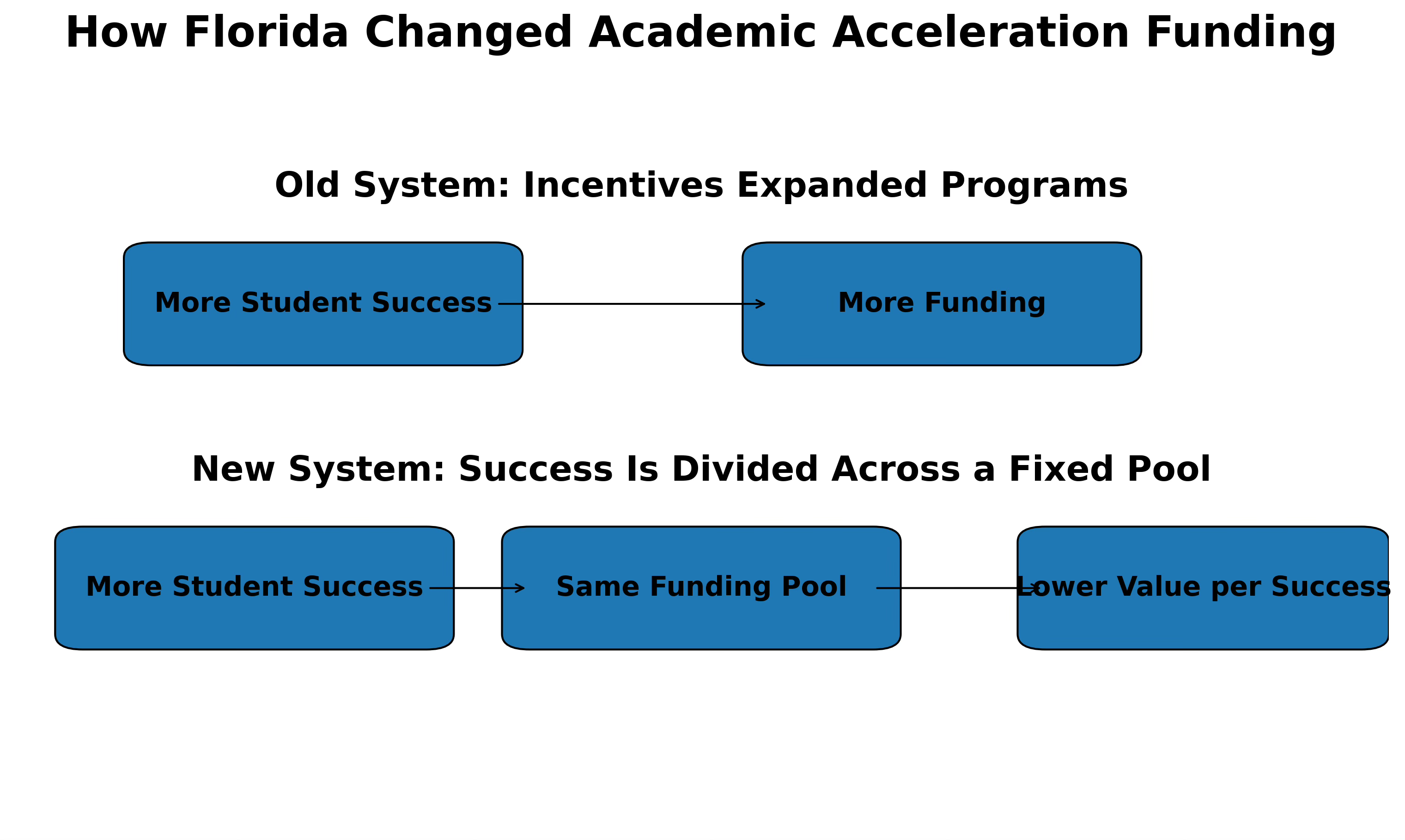
Under the old system, more student success generated more funding.
Under the new system, success is divided across a fixed pool. When more students succeed than expected, the value of each success simply gets prorated downward.
“Districts should not experience any change in funding,” said Senate PreK-12 Appropriations Chair Danny Burgess when announcing the new system.
Now that the numbers are in, we can see how that promise held up
The Back Story → How Florida Used to Fund Academic Acceleration
For more than a decade, Florida has encouraged students to enroll in rigorous coursework and career training by creating a layered system of incentives.
Students benefited through:
- Weighted GPAs
- College credit or industry certifications
- Expanded access to college-level courses and career programs
Teachers earned bonuses when students passed exams or earned certifications.
Schools benefited because the Florida Education Finance Program (FEFP) provided additional funding for successful outcomes. These “add-on weights” helped districts pay for the higher costs associated with advanced coursework and career programs.
Before the 2025-26 budget changes, schools received roughly:
- $865 for each successful AP, IB, or AICE exams
- Up to $1,622 for students completing a full CTE certification program
The incentives worked.
In 2020, Governor Ron DeSantis and Education Commissioner Richard Corcoran celebrated Florida’s national leadership in Advanced Placement participation, calling AP courses a “gateway to achieving success in college, career and ultimately in life.”
Career and Technical Education programs expanded as well. In February 2025, during Career and Technical Education Month, the Governor celebrated record participation, noting that more than 800,000 Florida students were enrolled in CTE programs.
The 2025-26 Funding Change
Last year’s budget replaced the open-ended add-on weights with a fixed categorical pool of funding called the Academic Acceleration Options Supplement.
For 2025-26, lawmakers allocated:
$596,771,896
Instead of each student success generating additional funding, the state now divides this fixed amount across all qualifying outcomes.
If student success exceeds projections, the value of each outcome simply gets prorated downward.
Florida students didn’t just meet expectations this year. They exceeded them.
That is exactly what happened.
Florida students exceeded the state’s projections across nearly every acceleration category:
- AP passing scores: +14% above projections
- AICE exam success: +13%
- Early graduation: +29%
- Industry certifications: +44%
Overall, the total number of acceleration outcomes ended up 20% higher than predicted.
Under the previous funding system, this surge in success would have meant more funding flowing to schools.
Under the new capped supplement, it meant the opposite.
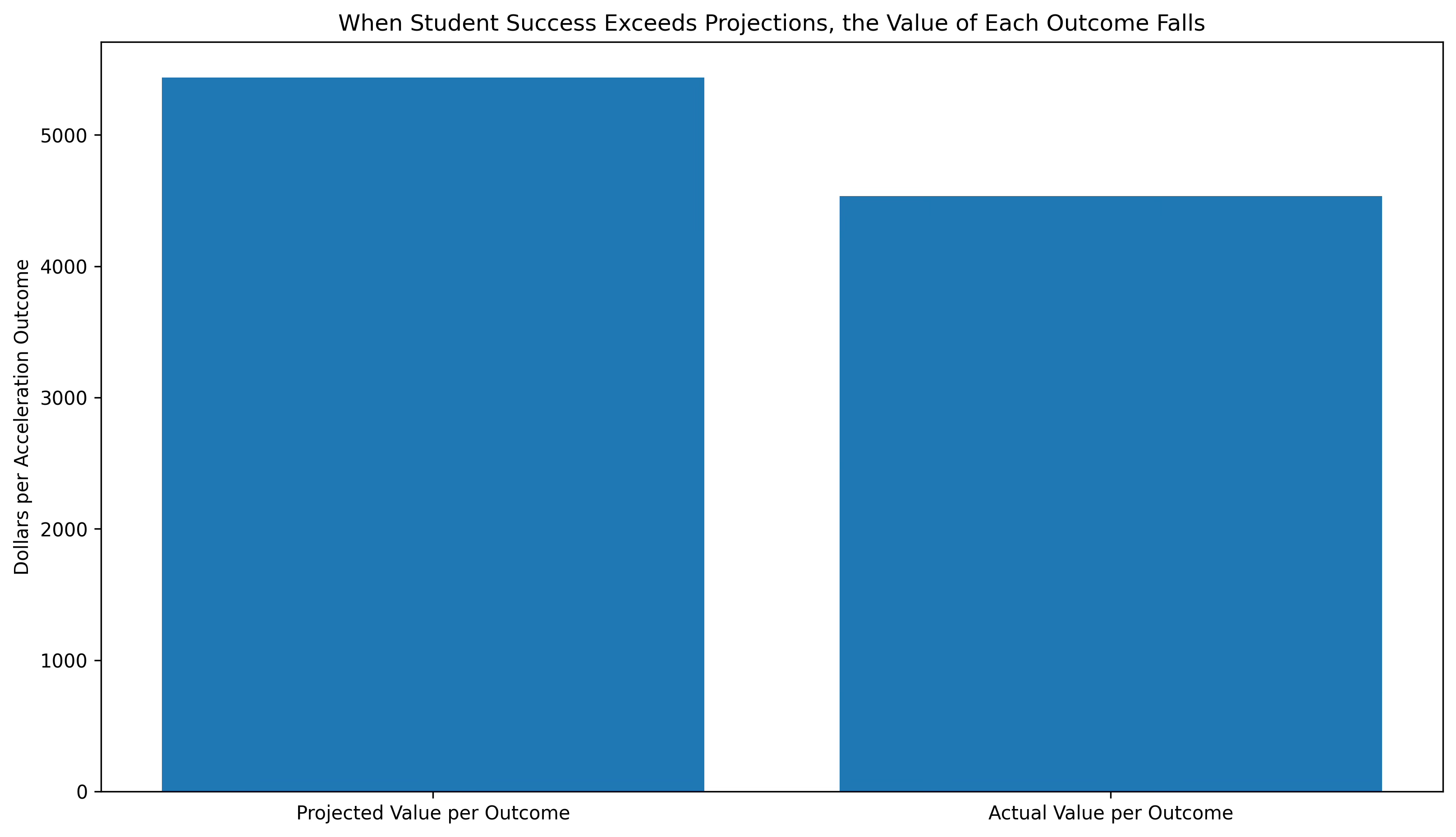
When the January FEFP recalculation was released, student success had grown far beyond projections. But because the funding pool remained fixed, the value of each outcome dropped significantly.
Florida students achieved 131,620 acceleration outcomes — far more than projected — but the funding stayed the same.
Success increased. Funding did not.
Looking Ahead to 2026-27: More of the Same
Last year, lawmakers extended the legislative session by six weeks to resolve disagreements over the state budget and tax package. This year may follow a similar path. The House and Senate budgets are currently $1.5 billion apart, and House Speaker Daniel Perez has acknowledged that completing the budget on time is “looking tough.”
But there is one thing both chambers appear to agree on.
Neither the House nor the Senate proposes increasing funding for the Academic Acceleration Options Supplement.
Both chambers have again allocated $596,771,896 — the same amount that already proved insufficient this year.
Lawmakers now know that Florida students earned significantly more acceleration funding than was paid out.
Yet next year’s budget proposal keeps the funding flat.
The Incentive Florida Used to Have
For more than a decade, Florida’s add-on weight system worked exactly as intended.
When more students passed AP exams, schools received more funding.
When more students earned industry certifications, schools received more funding.
When districts expanded advanced coursework and career programs, the funding followed the success.
That structure created a powerful incentive: expand opportunity, and the funding will support it.
And districts responded. Advanced coursework expanded. Career programs grew. Hundreds of thousands more students gained access to college-level classes and industry certifications.
The new Academic Acceleration Options Supplement changes that dynamic.
Instead of rewarding each additional success, schools now compete for shares of a fixed pool of money. When student achievement exceeds projections, the value of each outcome simply declines.
The old system said: expand these programs — Florida will reward the results.
The new system says: expand them if you want — but the funding may not follow.
Keep the Promise to Florida’s Students
“Florida students kept their promise to succeed.
Lawmakers should keep theirs.”
Parents and students overwhelmingly support advanced academic courses and career and technical education opportunities in their public schools.
Student success should generate investment in these programs — not trigger proration.
Last year, lawmakers promised full funding.
Now lawmakers need to keep that promise.
Call Senator Danny Burgess [(850) 487-5023] and Representative Persons-Mulicka [(850) 717-5078] and ask them to ensure that student success in programs like AP, IB, dual enrollment, and career certification is rewarded — not prorated.
.
This is exactly what Florida did a generation ago with Bright Futures. The original program started with a guarantee of paid in-state tuition for any students graduating with a B average. The Lottery was the major, but not sole, funding source. They soon started limiting it to the pool of lottery $ and eventually It became only a need-based program. Vouchers will end up the same way as their cost rises.