
Facing Deficits, Will Florida’s Lawmakers Look to Public Education for Reductions?
Since Florida’s Universal Vouchers were instituted, nearly all new state K-12 funding has gone to students who never attended public schools. Now, facing projected budget deficits once again, House Budget Chair Lawrence McClure has promised to “dig even deeper” for efficiencies, waste, and ineffective programs. Should vouchers be in the crosshairs?
On September 12, 2025, Florida’s Joint Legislative Budget Commission met and heard this fall’s Long-Range Financial Outlook (LRFO) for Fiscal Years 2026-27 through 2028-29. The LRFO is a constitutionally mandated report that presents recommended fiscal strategies to assist the legislature in making budget decisions. This year’s report brought both good news and bad news.
The Good News
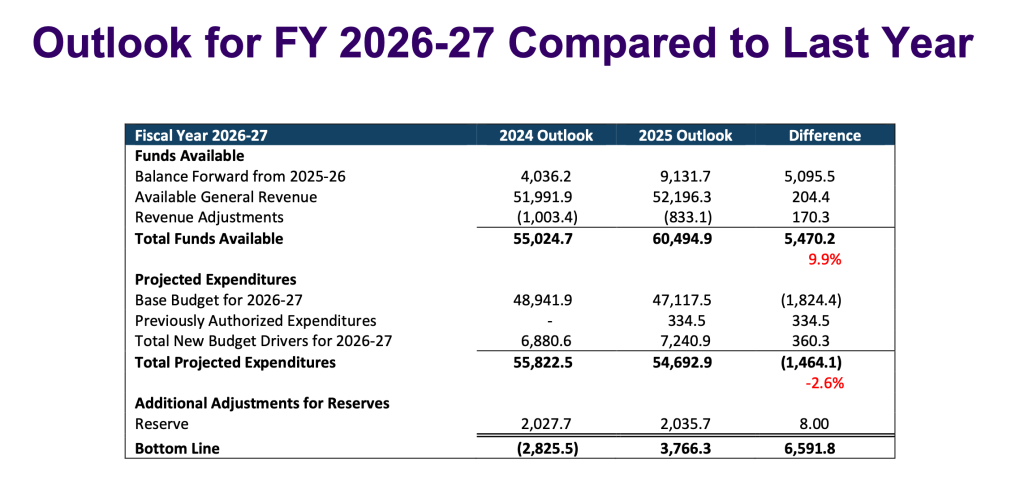
Actions taken by the Legislature in the 2025 Session significantly improved the state’s near-term financial position. For Fiscal Year 2026-27, the LRFO now projects a surplus of $3.8 billion, compared to last year’s projected deficit of $2.8 billion—a positive swing of nearly $6.6 billion. This improvement comes from a 9.9% increase in Funds Available, driven primarily by a higher balance forward from released contingency reserves and permanent redirects approved during the 2025 Session, along with a 2.6% reduction in projected expenditures due to budget adjustments made last session.
The Bad News
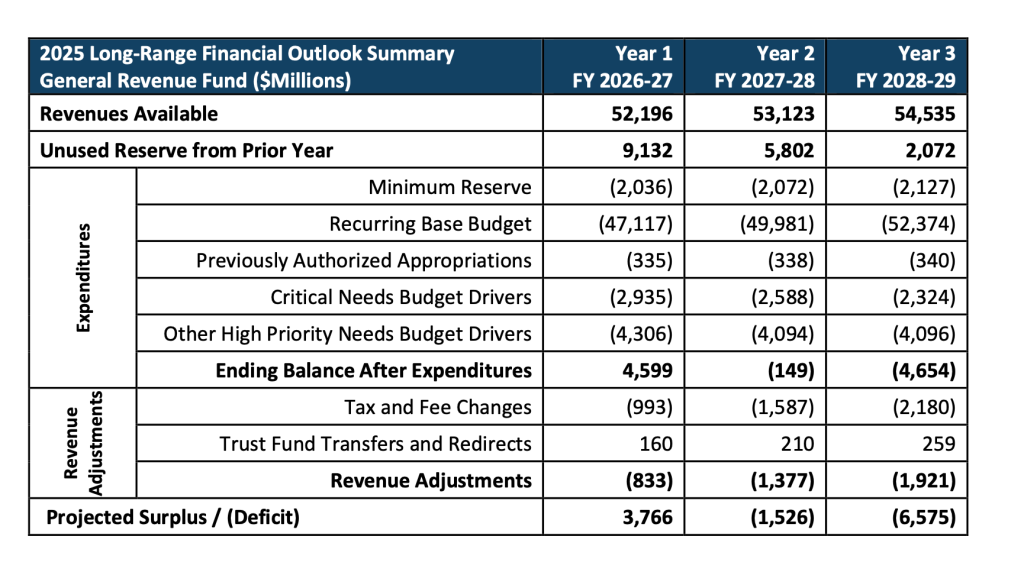
Projected budget deficits remain substantial in future years: $1.5 billion in 2027-28 and $6.6 billion in 2028-29. The committee warned that current revenue forecasts “will not support spending at its recent rate of growth,” meaning continued fiscal strategies are necessary.
House Budget Committee Chair Lawrence McClure noted the 2026-27 surplus but stressed that “our work is just not done… I intend for the House to dig even deeper this year for efficiencies, for waste, ineffective programs… everyone understands that we got to keep chipping away at this.” Senator Boyd agreed, vowing to “work real hard… to accomplish that.”
When asked about potential areas for cuts, Rep. McClure highlighted health care and education as the largest portions of the budget. He emphasized that services wouldn’t need dramatic reductions, but the challenges could be “easily solved” by “just not spending as much of the new money.”
Let’s examine where new state funding in K-12 education has gone in recent years.
First, it is important to understand that the LRFO only compares STATE General Revenue (GR) vs GR STATE Expenses. The State only funds part of the Florida Education Finance Program (FEFP). The rest is funded by local property taxes through a calculation called the Required Local Effort. In districts that are “property rich,” local property owners are asked to generate as much as 90% of their district’s FEFP funding (with the State chipping in the final 10%). In districts with lower property tax bases, the State contributes a larger percentage of the FEFP.
Lets compare the State GR and the FEFP in 2022-23 (the year before Florida enacted universal vouchers) and the current year FEFP 2nd Calculation.
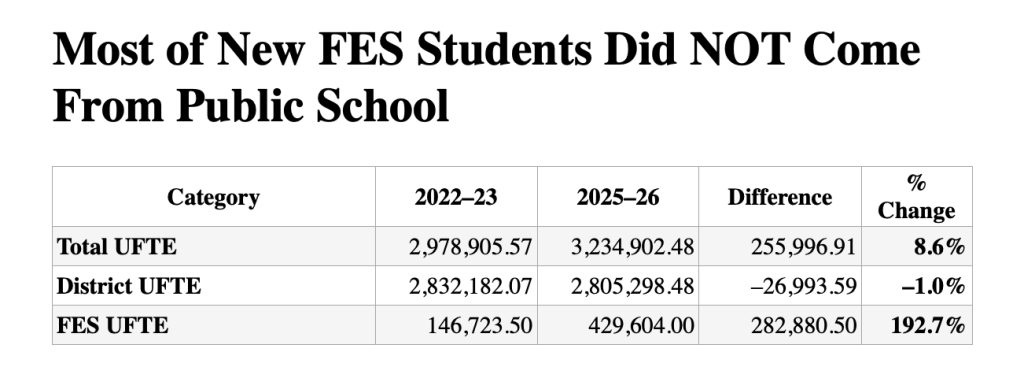
Since 2022-23, District enrollment (Unweighted Full Time Equivalent or UFTE) declined by almost 27K students but Total UFTE Enrollment increased by over 250K students. That growth was ALL in the Family Empowerment Scholarship (FES), which grew over 280K, including the almost 27K students who apparently left district operated public schools. The FEFP is now funding over 250K new FES students who were NEVER in district operated public schools. In other words, 95% of the new FES students were never in public schools.
Total STATE funding for the FEFP grew by $2.3 Billion since 2022-23, but STATE funding going to district and charter schools decreased by almost $300 Million. Meanwhile, STATE funding for FES vouchers increased by $2.5 Billion. The total increase of STATE funding in the FEFP of $2.3 Billion since 2022-2023 was driven by the increase of FES for students who were never in district operated schools. Remember, FES vouchers can only be paid for by state funds.
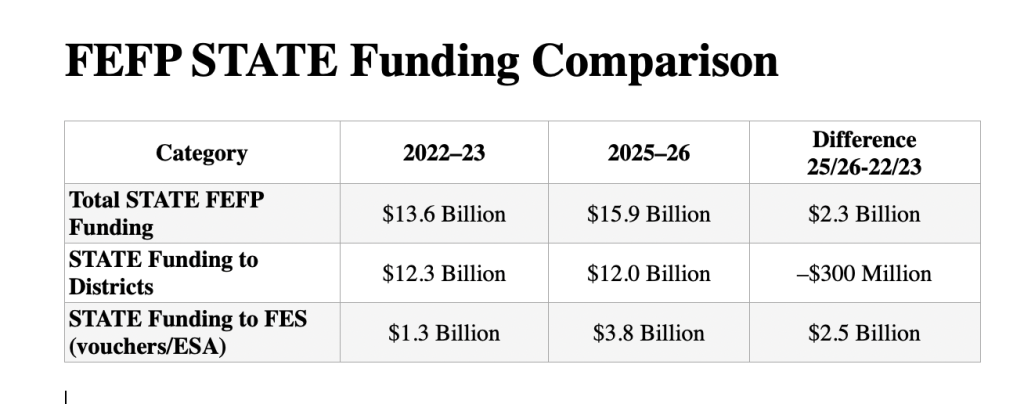
To be clear, this does NOT mean the FEFP formula generated LESS funding for District students year over year. Rather, the STATE contributed less and less to districts, requiring districts to raise more and more via their RLE or local property taxes, to the point that essentially ALL of the increases in STATE funding increases have gone to fund FES vouchers.
When you compare FES spending to recurring GR Revenue and Appropriations, you can see that STATE funding for FES vouchers has had a major impact.
- The growth in available recurring state GR from 2022-2023 until 2025-2026 was $2.9 billion, of which $2.5 Billion went to FES students. FES students who were never in public schools consumed approximately $2.3 Billion, or about 78% of the growth in available recurring state GR.
- Spending for recurring state GR increased about $8.3 billion. The $2.3 Billion spent for scholarships for students who were never in district operated schools accounted for about 27.3% of that increase. For the record, state funding for district managed public schools and charters accounted for NONE of that increase.
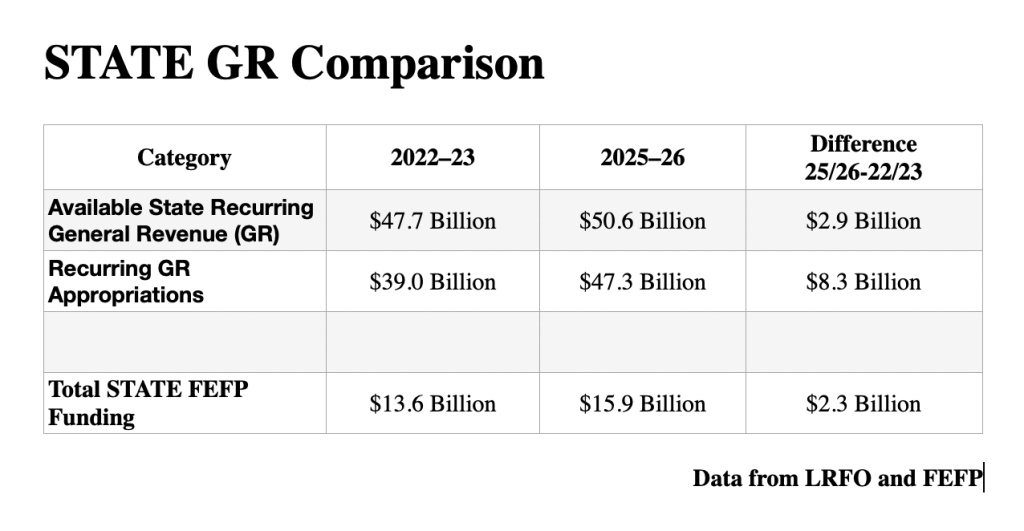
Since the expansion of Florida’s Universal Vouchers, nearly all new state K-12 funding has gone to students who were never enrolled in district schools. Meanwhile, traditional public schools have seen their state contributions shrink, forcing local communities to make up the difference. If lawmakers fail to address this trajectory, districts will continue to shoulder the financial burden, voucher programs will consume an ever-larger share of state resources, and Florida’s ability to maintain a stable, sustainable budget will be increasingly compromised. Florida cannot continue to turn a blind eye to the fiscal impacts of vouchers. Addressing voucher growth is no longer just an education issue—it’s a fiscal imperative.
I apologize but if you could help me understand, I’d be grateful.
I read this part of your blog, but I don’t understand it:
The total increase of STATE funding in the FEFP of $2.3 Billion since 2022-2023 was driven by the increase of FES for students who were never in district operated schools.
This is what my county put as their legislative priorities. I’m troubled by it. I wish they were more clearly advocating for increased funding for our public magnet and neighborhood schools.
The first item is really horrible but unique to my county. Item 2 is confusing to me. I’ve heard some districts aren’t getting funding when parents have applied for vouchers but then decide not to use them and their children attend the public school. Is this item #2 fixing that problem?
#3 says non-recurring funding. That seems a bad idea. Why not perpetual funding?
#4 Is this really important as a priority? Wouldn’t it be better to raise teacher salaries?
#5 This seems a good idea
#6 is this a good idea? Should it be a part of FEFP?
DUVAL COUNTY PUBLIC SCHOOLS
2025-2026 LEGISLATIVE PLATFORM
1. Local Authority for Independent Legal Counsel.
Duval County Public Schools seeks legislative authority to retain independent legal counsel, ensuring conflict-free, education-focused, and accountable representation consistent with other Florida districts. Local Bill J-1 will strengthen transparency, efficiency, and the Board’s constitutional duty to govern schools. Currently, attorney services are provided through the City of Jacksonville, limiting the School Board’s independent voice. This change would align legal representation with the Board’s vision and mission, free from outside influence.
2. Creating a Dedicated District Model for the Family Empowerment Scholarship (FES)
We request the Legislature establish a Dedicated Statewide District Model for the Family Empowerment Scholarship (FES). Modeled after existing statewide structures, this approach will align funding with real-time student enrollment, prevent double-counting, and ensure a transparent and stable system for all students.
3. The Student Safety Fusion Center: Florida’s Next Step in Student Safety
Duval County Public Schools requests the Legislature to fund a 24/7 Monitoring Operations Center—powered by the FUSUS platform-to ensure real-time school safety and position Florida as a statewide model for protecting students and staff. This request includes non-recurring funding for the software infrastructure that enables live video feeds and system integration across schools, enhancing rapid responses by school officials and first responders. The annual software cost is $500,000 for five years, a critical investment that goes beyond fixed capital outlay and provides the technological backbone for this safety initiative.
4. Modernize Teaching for the Al Era
Florida should invest in a statewide, teacher-centered approach to artificial intelligence (Al) in K-12 education. In alignment with the White House’s Advancing Al Education for American Youth, we urge the Legislature to fund Al-focused professional learning for teachers, embed Al literacy into teacher preparation programs and micro-credentials, and expand competitive grants or allocations for teacher training.
5. Strengthening Local Authority and Flexibility in Facility Planning
Duval County Public Schools calls on the Florida Legislature to address outdated and duplicative regulations governing public education facility planning by modernizing the Florida Inventory of School Houses (FISH) reporting system and establishing a formal appeals process for Castaldi determinations.
6. Increased Funding for Exceptional Education Students and English Language Learners
Duval County Public Schools urges the Legislature to increase funding for Exceptional Student Education (ESE) and English Language Learners (ELL) to meet mandated services and growing demand. Due to a shortage of specialized educators, districts must rely on costly emergency contracts, especially for Speech-Language Pathologists. We request higher ESE and ELL allocations in the Florida Education Finance Program (FEFP) and a targeted categorical fund to help high-need districts recruit and retain essential staff.