
Florida’s “School Choice” Boom? Most Families Still Choose Public Schools
Crossing the Rubicon… to Discover, once again, Parents Still Love Their Public Schools
If you have been following Florida’s K-12 education policy, you’ve probably heard the recent claim:
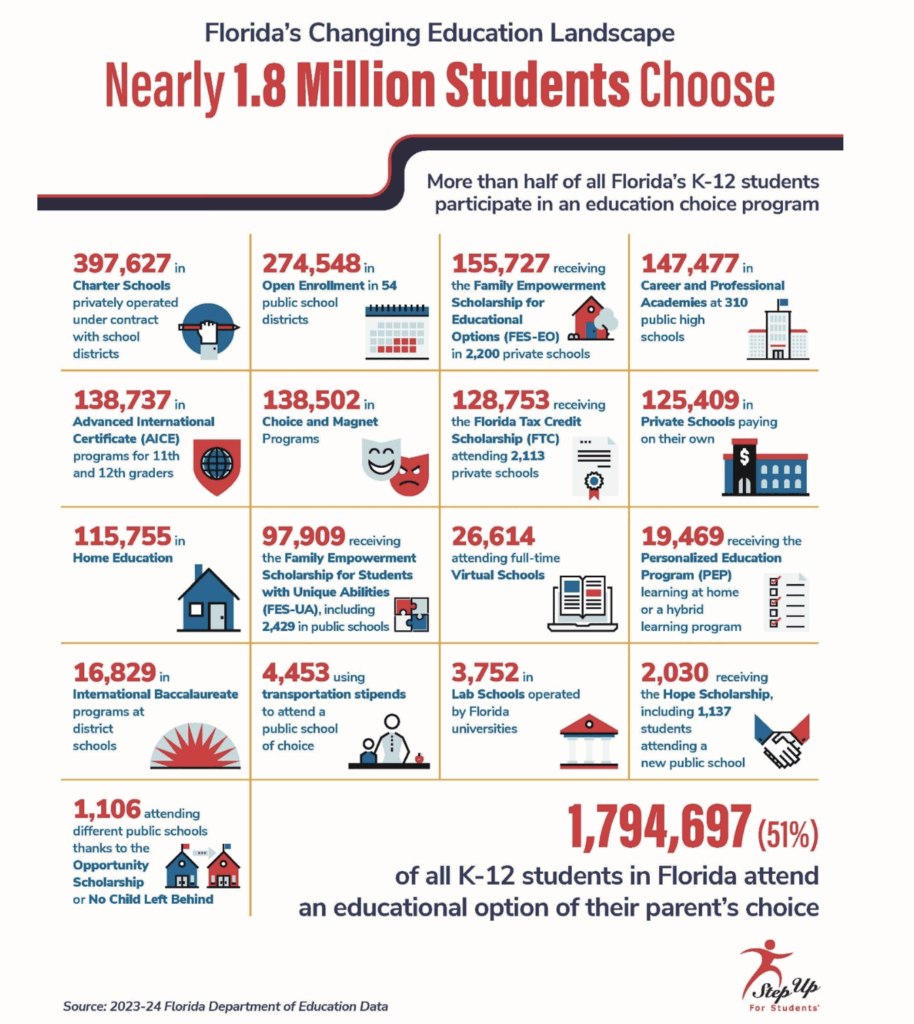
“For the first time in Florida’s history, more than half of all K-12 students are enrolled in an educational option of choice. During the 2023–24 school year, 1,794,697 students, out of the state’s approximately 3.5 million K-12 population, attended schools outside their zoned neighborhood assignment.” – Patrick Gibbons, public affairs manager at Step Up for Students and a research fellow for the Friedman Foundation for Educational Choice
Let’s take a look at that claim.
Every year, Step Up for Students—the politically connected, $5 billion-a-year “nonprofit” that administers most of Florida’s voucher programs—uses Florida Department of Education (FLDOE) data to spotlight the number of students they say are attending “schools of choice.” Each year, they celebrate the expansion of school choice while minimizing the fact that most families still choose their local public school. And each year (or most years, at least), I write a post pointing out that the majority of the “choice” being touted actually takes place within the public school system—through AICE, IB, magnet programs, open enrollment, career academies, and more.
To be clear, public school “choice” is nothing new. Magnet programs—originally created in the 1970s to offer academic variety while promoting desegregation—have long been part of Florida’s education landscape. In the early 1990s, public schools began establishing Career Academies, followed by the introduction of rigorous programs like IB and AICE in the late 1990s. These options remain popular with families today—though not as popular as simply attending their local public school. When you add the number of families who choose to attend their zoned public school to those choosing a choice option within their school district – the numbers are clear: Florida’s public schools continue to offer the most choice to our Florida families.
And that choice is often ignored.
This year, however, brought a surprising shift in tone. Patrick Gibbons, public affairs manager at Step Up, also wrote:
“…with so many students opting for alternatives to their zoned public schools, it raises an interesting question: What about those who stay? If families are surrounded by options and still choose their assigned public school, isn’t that a choice, too? In that light, Florida may already have a 100% choice system, because staying is just as much a decision as leaving.”
Exactly. Despite Florida’s “100% choice system”—year after year, the data proves that families overwhelmingly choose public schools and public school choice options.
But that is never the headline.
Instead:
- The Wall Street Journal called it a “school choice boom,” claiming it was “evidence that parents are eager to exercise it.”
- Central Florida Public Media warned that “this trend spells trouble for traditional public schools.”
- The Koch-funded Yes Every Kid named Florida the “#1 state for education freedom.”
- Florida Politics dubbed school choice “almost (but not quite) the biggest winner” of the week.
- William Mattox of the James Madison Institute said Florida has “crossed the Rubicon,” and that education choice is “the new normal.” To his credit, he did acknowledge that many students benefiting from this shift are doing so through public school choice programs—charters, magnets, and open enrollment.
But “many” is an understatement. It’s actually MOST Florida families exercising choice are exercising public school choice.
Here’s what the numbers really say:
- 49% of Florida’s K–12 students still attend their assigned public school—making it the most popular option – by far.
- Among the remaining 51% (1.79 million) K-12 students exercising “choice,” 40% (725,218 students) choose public school choice options like magnets, open enrollment, IB, and AICE.
- 22% (400,322 students) use a variety of vouchers through Step Up.
- Another 22% attend charter schools.
- The remaining 13% are in private pay options or homeschooling.
Step Up notes that FLDOE “cleans up” the data regularly—removing, “where possible,” duplicate counts to avoid double-dipping. This likely explains the nearly 70% drop in reported “choice and magnet” enrollment (almost 100,000 students) since 2020—and may be the statistical trick behind this year’s so-called Rubicon crossing. (If Choice and Magnet schools had seen a dramatic drop in enrollment, that would be a story- I suspect, previously, FLDOE was including students whose assigned school was already a Magnet))
Conclusion:
Florida families are making choices—but the overwhelming majority still choose public education, whether through their zoned schools or innovative programs within the public system. The narrative of a school choice revolution may serve political ends, but it doesn’t reflect the full picture. Public schools remain the bedrock of Florida’s education landscape—and that’s a headline worth printing.
I am a public school teacher of two, both are on the homeschool scholarship. Our district offers classes for my kids to take that we pay for with the UA. So now both my kids are not enrolled in our district but my district makes money educating them. Does your district do something like this?
This is being heavily pushed by Step Up. My district does not at this time. We continue to educate non-voucher homeschool students on a part-time basis as we always have.
Question: Do your children receive IEP-related special education supports and/or services when they take purchased courses through the district? Does the district charge differently for students with special needs or is the fee the same as for any PEP student?
It’s very basic right now, no different service, basically a reading tutoring class.
The district wasn’t honoring our IEP in the first place which is why got UA. Don’t have the resources for the legal costs to enforce. She is treated better now that we’re paying the district.