
Who Lives With the Consequences?
Erika Donalds says parents should choose their children’s education and live with the consequences. Bruce Baker asks what happens to the children when those choices fail.
In an October 14 WGCU interview, Dayna Harpster sat down with Erika Donalds, the wife of Florida gubernatorial candidate Byron Donalds, to discuss her vision for education and the role she might play as Florida’s next First Lady.
Donalds is no newcomer to Florida’s education debates. A former Collier County school board member, school choice advocate, charter school founder, and owner of businesses providing services to charter schools, she has spent years promoting a marketplace approach to public education. If her husband is elected governor, she told Harpster, she expects to continue that work from a larger platform.
Harpster asked some important questions about academic outcomes, school accountability, Donalds’ financial interests in charter schools, and what happens to children when schools close.
Some of Donalds’ answers deserve a closer look.
First, a few facts
Donalds claimed that Florida charter schools have outperformed traditional district schools in nearly every subject and grade, including among disadvantaged students.
Florida’s own Department of Education reports something more nuanced. In its 2024–25 comparison, charter students outperformed district students in 55 of 77 academic achievement comparisons. That’s a majority, but hardly every comparison.
More importantly, these are descriptive comparisons, not studies establishing that charter schools produce better academic outcomes for otherwise comparable students. Although the report breaks down results by demographic subgroups, it does not adequately account for differences in students’ prior achievement, family circumstances, or other factors that can influence academic performance.
And there is another complication. Florida law allows certain charter schools to establish academic eligibility standards and, under specified conditions, dismiss students who fail to meet them. District public schools, meanwhile, must continue educating eligible students regardless of their academic performance.
The DOE report includes only students enrolled for the full school year and does not examine whether students who leave charter schools differ academically from those who remain.
Comparing the performance of the students who remain enrolled is not the same as measuring the educational effectiveness of the schools they attend.
Donalds also pointed to nearly 100 studies of school choice, saying most showed positive effects. That claim resembles research summaries promoted by EdChoice, a national organization dedicated to expanding private school choice. Its annual reviews catalog approximately 200 studies and report that the overwhelming majority found positive effects.
But EdChoice’s compilation is not a meta-analysis, and its favorable numbers combine studies examining everything from parental satisfaction and fiscal savings to school safety and academic achievement.
More importantly, some of the most rigorous evaluations of large-scale voucher programs have found substantial academic losses. Studies in Louisiana, Indiana, Ohio, and Washington, D.C., documented negative achievement effects among participating students. Education researcher Josh Cowen has compared the magnitude of some of those losses to the academic disruptions associated with COVID-19 and Hurricane Katrina.
Not every voucher program has produced negative academic results, of course. But counting studies that found benefits across a variety of measures does not answer the central question: Are students receiving a better education?
A hundred favorable findings about school choice are not the same thing as a hundred studies demonstrating that children learned more.
And then there was her explanation of school closures.
Donalds portrayed declining district enrollment as evidence that parents are rejecting schools that fail to meet their needs. When those schools become financially unsustainable and close, she explained:
“That’s exactly what should happen.”
But is that actually why Florida’s schools are losing students?
Florida’s January 2026 Education Estimating Conference reduced its statewide K–12 enrollment forecast by more than 46,000 students, observing unexpected declines across district, private, and home education settings. State economists identified the chilling effects of immigration policies as the most likely explanation.
Other demographic forces may also be contributing. Florida’s high housing costs, changing migration patterns, and declining birthrates raise serious questions about whether communities are losing families with school-age children, even as they continue attracting other residents.
School choice undoubtedly contributes to changing enrollment patterns. But enrollment declines do not prove that families are abandoning academically unsuccessful schools for better ones.
Nor does a school closing necessarily demonstrate that market accountability is working.
A school is not simply another business
There is an important distinction between a school district closing a neighborhood school and a private operator closing a school.
When a district closes a school, its responsibility to the children doesn’t end. It must accommodate them elsewhere, arrange for their continued education, address transportation and specialized services, and manage the disruption to families and communities.
When a private operator closes a school, it is not obligated to open another school or continue educating those students indefinitely. The families must find somewhere else to go, often returning to their local public school.
The public education system remains the backstop.
And the loss of a public school is not merely financial. Neighborhood schools are community institutions. They are community investments. Closures can mean longer commutes, disrupted relationships, the loss of familiar teachers and services, and the disappearance of an important center of community life.
There is another distinction worth remembering: A school can be academically successful and still close because there are too few children living nearby. Conversely, a school can remain financially viable because parents continue enrolling their children without necessarily producing strong academic outcomes.
Market survival is not the same thing as academic success.
Living with the consequences
Ms. Donalds said something else that was even more revealing. While explaining how she would change the culture of public education, Donalds proposed putting parents in control of the education funds associated with their children. They would decide whether those dollars went to a neighborhood public school, charter school, private school, or customized educational arrangement.
Then she added:
“The fact that the parents are the ones taking responsibility for that decision, and then living with the consequences of that decision, I think changes the culture of publicly funded education.“
“Living with the consequences.” Think about that for a moment.
Of course parents should be empowered to make decisions about their children’s education. But who, exactly, lives with the consequences when those decisions turn out badly? HINT: not just the parent.
Just twelve days before the interview, University of Miami education finance expert Bruce Baker published an essay titled Experimenting With Our Children: Who Answers to the 18-Year-Old the Voucher Failed?
Baker examines what happens when the state provides public money for an educational arrangement but requires little evidence that the child is actually learning. (He’s looking at you Florida.)
He imagines a young adult who has spent years in a publicly funded education program but reaches age 18 without basic literacy skills.
What recourse does that young adult have? Can she hold her parents accountable? The educational provider? The state that paid for her education?
Baker examines those possibilities and finds the legal avenues remarkably limited.
The consequences, meanwhile, can last a lifetime.
Two visions of educational accountability
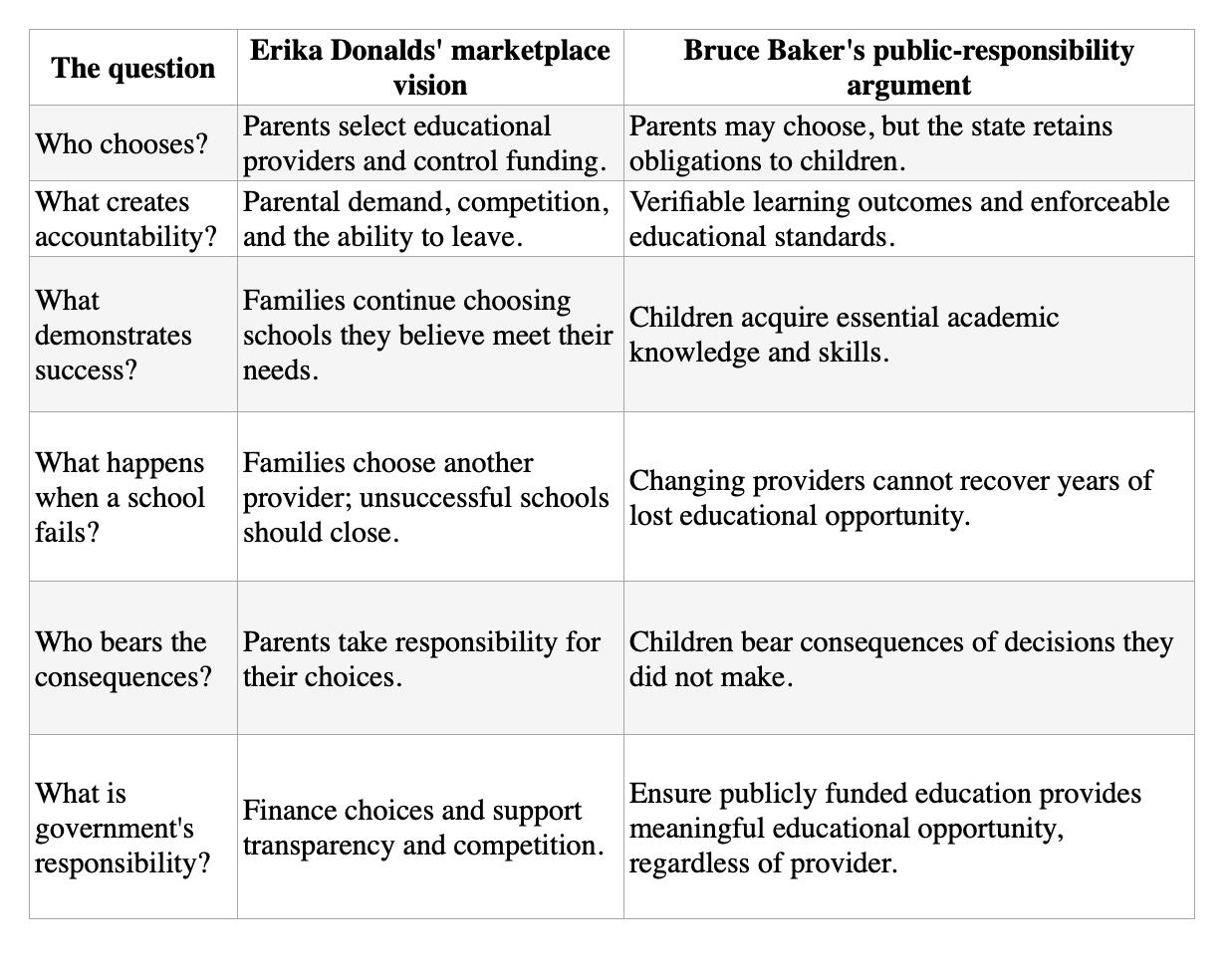
These views are not necessarily incompatible. Parental choice and public accountability can coexist. But they reflect different starting points.
Ms. Donalds focuses on the rights and responsibilities of the parent making the educational decision.
Dr. Baker focuses on the rights and interests of the child receiving the education.
And that difference matters enormously when the choices don’t work out.
What if parents don’t have the information they need?
Donalds does acknowledge that informed decisions are essential to her vision:
“As long as we make sure parents have all the information they need to make those decisions, I believe in accountability through transparency and allowing parents to vote with their feet.”
That sounds reasonable.
Except Florida has not made comparable academic information available across its publicly funded education system.
District and charter schools operate under Florida’s A–F accountability system. Their academic achievement, learning gains, and school grades are publicly reported.
Private schools accepting taxpayer-funded scholarships are not subject to that same accountability system. Scholarship students in grades 3–10 generally must be tested, and parents receive their children’s results, but private schools do not receive A–F grades. The academic information made public is substantially less comprehensive and less comparable.
Students participating in Florida’s Personalized Education Program (PEP), which allows parents to purchase an assortment of educational services, must also complete annual assessments. But continued scholarship funding is not contingent upon demonstrating adequate academic progress.
A parent might be entirely satisfied with a school’s religious environment, disciplinary approach, flexibility, or personal attention without realizing that the child is falling further behind academically.
And a parent considering a school cannot necessarily obtain reliable, comparable evidence about how well that school’s students are learning.
Interestingly, Donalds has previously objected to proposals that would impose more comparable regulatory requirements on publicly funded private schools, describing such requirements as burdensome regulations rather than arguing for extending the existing public-school system’s rules to other providers.
So there is a question worth asking:
If parental choice is supposed to provide accountability, why hasn’t Florida ensured that parents have access to the information necessary to make those choices intelligently?
And why should parents be expected to live with the consequences of decisions made without access to information the state routinely provides about its public schools?
What happens when the experiment fails?
Baker begins his essay by recalling a 2013 Kansas school-finance decision in which judges warned against experimenting with children’s educational opportunities.
Their essential point was that educational opportunities do not simply repeat themselves. When those opportunities are lost, they may be gone forever.
That observation is particularly relevant to education savings accounts and other highly individualized educational arrangements.
Consider a child whose parents assemble an education from online programs, tutors, enrichment activities, and other approved purchases. Perhaps the arrangement works beautifully. Many undoubtedly do.
But what happens if it doesn’t?
What if a child reaches middle school unable to read proficiently? What if that child reaches adulthood without the academic foundation needed for employment, higher education, or independent life?
The parents might have made their decisions with the best intentions. The providers may have delivered exactly the services purchased. The state may have verified that the money was spent on approved expenses.
Yet the child may still have been denied a meaningful education.
And, as Baker explains, there may be no effective mechanism for holding anyone responsible for the lost opportunity.
That is the limitation of treating educational accountability primarily as a matter of consumer choice.
The marketplace can respond when families stop purchasing a service. But it cannot give a child back the third grade, the fifth grade, or the high school years.
Nor can it guarantee that an adult who selected an educational provider understood whether that provider was delivering an adequate education.
The obligation that remains
Florida’s Constitution declares that providing a high-quality education to all children is a paramount duty of the state.
That obligation has meaning beyond financing individual purchases.
It is why public school districts must continue serving children even when a neighborhood school closes, enrollment declines, or providing services becomes more expensive.
It is also why publicly funded educational options raise questions that ordinary consumer marketplaces do not.
A parent can choose a restaurant and have a disappointing meal. The consequences are usually temporary.
A parent can choose an educational arrangement that fails a child for years. The consequences may be permanent.
The child did not choose the school, select the curriculum, approve the purchases, or decide whether the instruction was sufficient.
Yet that child is the one who must carry the consequences into adulthood.
This is not an argument that parents shouldn’t have choices or that every district school provides an adequate education. It is an argument that choice alone is not a substitute for educational accountability.
Parents should be able to make informed decisions. Schools and other providers should be expected to demonstrate that children are learning. And when public money pays for an education, there must be an identifiable public responsibility for ensuring that education is meaningful.
Donalds wants parents to take responsibility for their choices and live with the consequences.
Baker asks us to consider the child who had no choice in the matter.
But there is another party to this arrangement: the taxpayers who are being asked to finance those choices, often without comparable evidence that the education they are purchasing is actually being delivered.
What happens when a child reaches adulthood without the basic skills needed to support themselves, pursue further education, or participate fully in society? Who is responsible for making up for the education they never received?
The parents may have made their decisions with the best intentions. The provider may have collected years of taxpayer-funded payments and moved on. The child is left with the consequences, and taxpayers may be called upon to pay again through remedial education, workforce training, or other public services.
But Florida’s Constitution does not identify parental choice as the state’s paramount duty. It identifies the education of children.
Article IX, Section 1 declares that it is the state’s “paramount duty” to make adequate provision for the education of all children residing within its borders.
The Legislature can expand educational options. It can allow public dollars to follow children into private schools or parent-directed educational arrangements. But those policy decisions raise a fundamental question: How does the state ensure that its constitutional responsibility to children is being fulfilled?
If the Legislature chooses to use public funds to finance a parent’s educational choice, shouldn’t it also be responsible for ensuring that the child actually receives an education?
Because parents may make the choices, and taxpayers may pay the bills.
But it is the children who must live with the consequences.